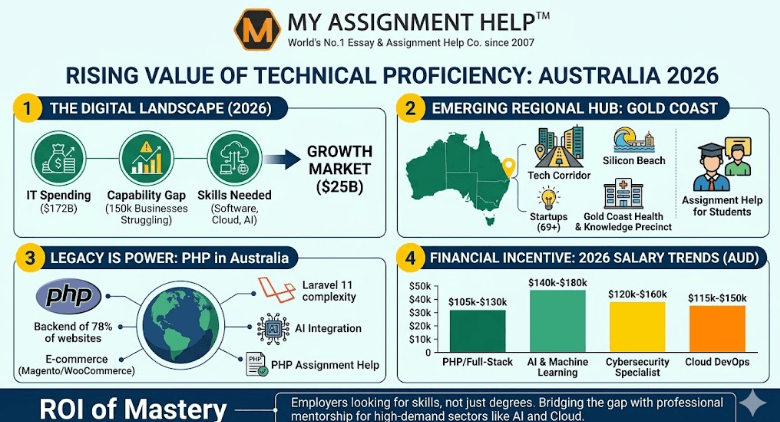
The Australian digital landscape is currently navigating a pivotal era. By the end of 2026, IT spending in Australia is projected to surpass $172.3 billion, an 8.9% increase driven largely by a voracious appetite for software services, cloud migration, and AI-driven automation. However, this financial surge has exposed a critical “capability gap.” According to the ACS Digital Pulse report, nearly 150,000 Australian businesses are struggling with severe shortages in digital capability.
In this high-stakes environment, the value of “Technical Proficiency” has shifted from being a resume addition to a prerequisite for economic survival. For the modern Australian professional, mastering specific programming logic and understanding regional infrastructure is no longer just about getting a job—it is about securing a future in a $25 billion growth market.
The Gold Coast: Australia’s Emerging “Silicon Beach”
While Sydney and Melbourne have traditionally been the heavyweights of the Australian tech scene, 2026 has seen a dramatic shift toward regional hubs. The Gold Coast, in particular, has transformed from a tourism-centric economy into a sophisticated technology corridor. With over 69 high-growth startups currently scaling in the region—ranging from AI computer vision firms to radiotherapy innovators—the demand for local talent has reached an all-time high.
The pressure on the local talent pipeline is immense. As university completions struggle to keep pace with industry needs, many students and transitioning professionals find that maintaining academic performance while keeping up with rapid industry shifts is a significant hurdle. This is why many are seeking expert assignment help gold coast to bridge the gap between theoretical classroom learning and the rigorous technical standards required by Queensland’s booming tech employers. By securing professional support, students ensure they master the high-level concepts needed to contribute to the Gold Coast Health and Knowledge Precinct and other local innovation hubs.
Why PHP Remains a Sovereign Power in Australian Web Development
A common misconception in the developer community is that older languages fade into irrelevance. In reality, the Australian business sector remains heavily reliant on PHP. In 2026, PHP powers the backend of nearly 78% of the world’s websites, and its footprint in Australia’s e-commerce sector—via platforms like Magento and WooCommerce—is massive.
For those pursuing a career in web architecture, the complexity of server-side logic in modern frameworks like Laravel 11 can be daunting. Understanding the nuances of “clean core” principles and scalable data pipelines often requires more than just basic lectures. Professionals who seek PHP Assignment Help are often better positioned to handle real-world challenges, such as integrating AI trainers into existing PHP-based CMS platforms or managing the server-side requirements of Australia’s $10 billion data centre expansion.
The Financial Incentive: 2026 Salary Trends
The data is clear: technical proficiency pays. In the current Australian market, a skilled PHP developer can expect an average annual salary ranging from $100,000 to $120,000, with senior roles in high-demand regions like Perth or the Gold Coast often exceeding these benchmarks due to local talent shortages.
| Skill Category | Projected Demand Growth (2026) | Avg. Salary Range (AUD) |
| PHP/Full-Stack Development | 12% | $105k – $130k |
| AI & Machine Learning | 25% | $140k – $180k |
| Cybersecurity Specialist | 18% | $120k – $160k |
| Cloud DevOps | 15% | $115k – $150k |
The ROI of Mastery: Beyond the Degree
The 2025 APS Digital Workforce Insights Report highlighted a startling fact: nearly half of Australian IT graduates feel their university qualifications aren’t fully relevant to their current roles. This “relevance gap” is where technical proficiency becomes the ultimate differentiator.
Employers are increasingly looking past the degree and toward demonstrable skills. Whether it is building a bespoke booking system for a Gold Coast startup or optimizing a legacy PHP database for a national retailer, the ability to execute complex technical tasks is the primary currency of 2026.
Key Takeaways for Students and Professionals
- Regional Growth is Real: Don’t ignore hubs like the Gold Coast; they offer high salaries with often better lifestyle parity.
- Legacy is Power: PHP is not “dead”; it is the backbone of the Australian e-commerce economy.
- Bridge the Gap: Use professional academic resources to ensure your technical understanding meets industry-grade standards.
- ROI Focus: Align your learning with high-growth sectors like AI integration and Cloud-native platforms.
See also: How Startups Leverage Cloud Technology
Frequently Asked Questions (FAQ)
1. Is the Gold Coast a good place for a tech career in 2026?
Absolutely. With the rise of “Silicon Beach” and the expansion of the Gold Coast Health and Knowledge Precinct, the region is seeing a surge in startups and tech investments, offering competitive salaries compared to Sydney and Melbourne.
2. Why should I learn PHP when newer languages are available?
PHP remains a staple for Australian businesses due to its massive ecosystem (WordPress, Magento, Laravel). Most e-commerce and CMS-driven sites in Australia still rely on PHP, ensuring long-term job security and a high volume of maintenance and development roles.
3. How do I manage the difficulty of technical assignments?
Modern technical education is fast-paced. Utilizing specialized assignment help can provide the mentorship and clarity needed to master complex server-side logic and database management, ensuring you remain “job-ready.”
4. What is the biggest tech talent shortage in Australia right now?
While software engineering has eased slightly, there are acute shortages in AI implementation, Cybersecurity, and Cloud Architecture. Professionals who can bridge these gaps are commanding the highest salary premiums.
About the Author
James Harrison is a Senior Academic Consultant and Content Strategist at MyAssignmentHelp. With over a decade of experience in the Australian digital marketing and education sector, James specializes in helping students navigate the complexities of SEO, technical web development, and regional economic trends. He is a passionate advocate for data-driven learning and practical technical proficiency.
References
- ACS Digital Pulse Report 2025/2026: “Today, Meet Tomorrow.”
- Gartner Forecast: IT Spending in Australia (January 2026).
- Jobs and Skills Australia (JSA) Occupational Shortage List 2025/2026.
- SEEK Career Insights: PHP Developer Salary Benchmarks April 2026.
- APS Digital Workforce Insights Report 2025.
